

Key Takeaways
- The Australian Dollar (AUD) showed resilience against the US Dollar (USD) following recent S&P Global PMI data.
- Traders are anticipating crucial Australian quarterly inflation figures next week, which could influence the RBA’s monetary policy decisions.
- Rising bets on a near-term RBA rate cut are creating headwinds for the AUD, exacerbated by a recent uptick in the unemployment rate.
- Global economic factors, including US-China trade relations and US government shutdown, add to market uncertainty.
- Technical analysis suggests a bearish bias for AUD/USD, with key support levels to watch closely.
AUD/USD Market Dynamics
The Australian Dollar (AUD) has found stability against the US Dollar (USD) after the release of preliminary S&P Global Purchasing Managers’ Index (PMI) data on Friday. Market participants are now keenly awaiting key quarterly inflation data for Australia, scheduled for release next week. These figures are expected to provide significant insight into the Reserve Bank of Australia’s (RBA) future monetary policy direction.
The preliminary S&P Global Manufacturing PMI for Australia indicated a slight contraction, falling to 49.7 in October from the prior month’s reading of 51.4. Conversely, the Services PMI demonstrated growth, rising to 53.1 in October from 52.4 previously. The Composite PMI also edged higher, reaching 52.6 in October compared to 52.4 in the preceding month.
RBA Governor Michele Bullock delivered remarks in Sydney but refrained from commenting on monetary policy or the broader economic landscape. Her statements focused on the central bank’s plans to modernize the interbank settlement system, a critical component of the nation’s payment infrastructure processing approximately A$300 billion in daily transactions, as reported by Reuters.
Factors Influencing the Australian Dollar
The Australian Dollar faces potential challenges due to increasing market expectations of a near-term interest rate cut by the Reserve Bank of Australia (RBA). This sentiment was significantly bolstered by the latest employment report, which showed the jobless rate climbing to its highest level in nearly four years in September. This unexpected increase has led traders to ramp up the probability of a 25-basis-point rate cut to 70%, a substantial rise from approximately 40% a week earlier.
On the international front, the White House confirmed that President Donald Trump is scheduled to meet with Chinese leader Xi Jinping next week, coinciding with high-level trade talks during the ASEAN Summit. Any shifts in China’s economic conditions could undoubtedly impact the Australian dollar, given the robust trade relationship between the two nations.
US Dollar Performance and Market Sentiment
The US Dollar Index (DXY), which tracks the USD against a basket of major currencies, is currently trading around 99.00. Traders are advised to exercise caution ahead of the release of US inflation data for September, particularly amid the ongoing government shutdown which has led to a blackout of key economic indicators.
✅ The Greenback has received some support following President Trump’s statement on Wednesday, expressing optimism about reaching several agreements with Chinese President Xi Jinping during their upcoming meeting. Discussions are anticipated to cover a range of topics, including US soybean exports, nuclear weapons limitations, and China’s purchases of Russian oil.
⚡ The prolonged US government shutdown presents a significant headwind for the US Dollar, delaying crucial economic data releases such as Nonfarm Payrolls (NFP). This uncertainty complicates financial markets and the Federal Reserve’s (Fed) decision-making process.
📍 The US government shutdown has now entered its 24th day, marking the second-longest federal funding lapse in history, with no immediate resolution in sight. A GOP-backed stopgap bill failed to pass the Senate for the 12th time on Wednesday evening.
📊 Analysts widely anticipate the Federal Reserve to cut interest rates by 25 basis points (bps) to 3.75%-4.00% in its monetary policy announcement on October 29. Furthermore, a significant majority of economists expect the Fed to implement two rate cuts this year, with a notable portion anticipating one cut.
💡 The CME FedWatch Tool indicates that markets are pricing in a strong likelihood of a Fed rate cut in October, with a high probability of another reduction in December.
📌 In China, the People’s Bank of China (PBOC) maintained its one- and five-year Loan Prime Rates (LPRs) unchanged at 3.00% and 3.50%, respectively.
📈 China’s Gross Domestic Product (GDP) grew by 4.8% year-over-year in the third quarter, aligning with expectations and following a 5.2% growth in the second quarter. The economy expanded 1.1% quarter-over-quarter, surpassing market consensus.
🤝 President Trump and Australian Prime Minister Anthony Albanese finalized a significant critical minerals agreement valued at USD 8.5 billion. This accord aims to secure access to Australia’s vital rare-earth resources amidst China’s tightening export controls. Both nations have also committed to substantial investments in mining and processing projects over the next six months.
AUD/USD Technical Outlook
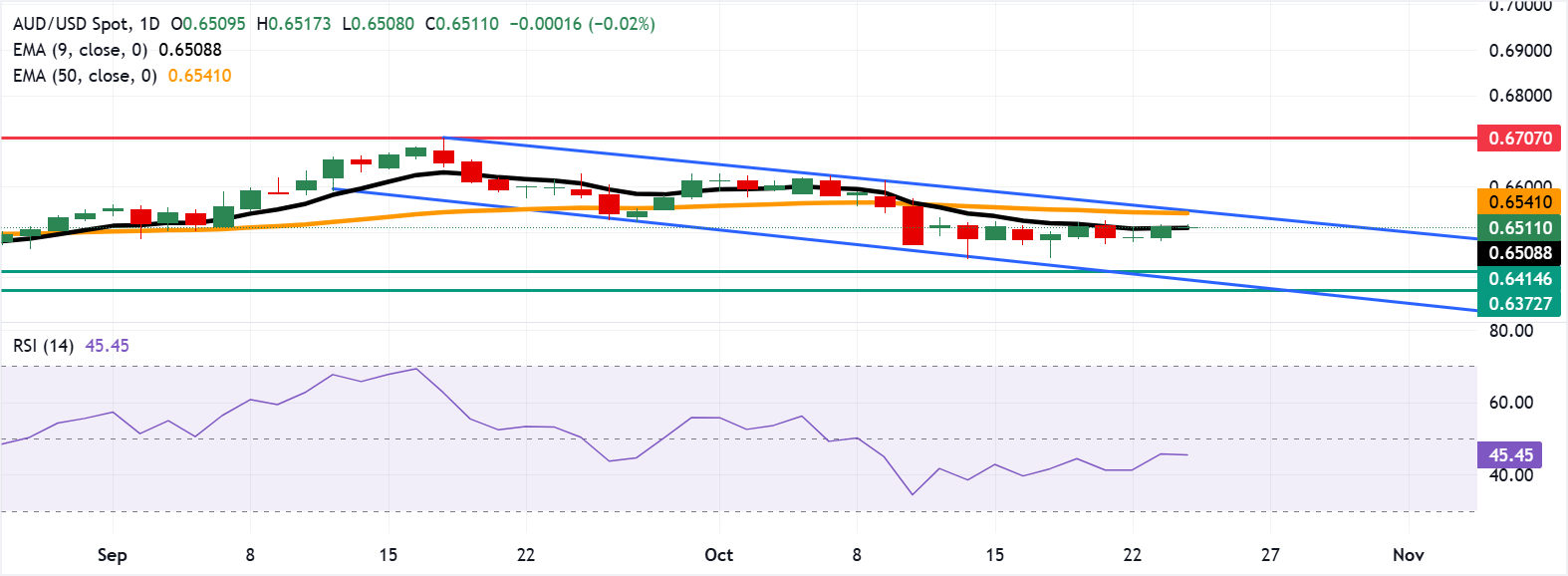
The AUD/USD pair is currently trading near 0.6510. Technical analysis of the daily chart reveals a persistent bearish bias, with the pair trading within a descending channel. The 14-day Relative Strength Index (RSI) remains below the 50 level, further supporting this bearish outlook.
On the downside, the AUD/USD pair may test the four-month low of 0.6414, followed by the lower boundary of the descending channel situated around 0.6390. A decisive break below this confluence support zone would intensify the bearish sentiment and potentially lead the pair towards the five-month low of 0.6372.
The AUD/USD pair is observed hovering around the nine-day Exponential Moving Average (EMA) at 0.6508. A successful breach above this level could improve short-term price momentum and pave the way for the pair to test the 50-day EMA at 0.6541, which aligns with the upper boundary of the descending channel.
Australian Dollar Price Performance Today
The heatmap below illustrates the daily percentage change of the Australian Dollar (AUD) against major currencies. The Australian Dollar has shown the strongest performance against the Japanese Yen today.
| USD | EUR | GBP | JPY | CAD | AUD | NZD | CHF | |
|---|---|---|---|---|---|---|---|---|
| USD | 0.07% | 0.01% | 0.18% | -0.00% | 0.02% | 0.03% | 0.05% | |
| EUR | -0.07% | -0.05% | 0.11% | -0.05% | -0.04% | -0.03% | -0.01% | |
| GBP | -0.01% | 0.05% | 0.16% | -0.01% | 0.01% | 0.00% | 0.04% | |
| JPY | -0.18% | -0.11% | -0.16% | -0.17% | -0.16% | -0.16% | -0.13% | |
| CAD | 0.00% | 0.05% | 0.01% | 0.17% | 0.01% | 0.03% | 0.04% | |
| AUD | -0.02% | 0.04% | -0.01% | 0.16% | -0.01% | 0.00% | 0.02% | |
| NZD | -0.03% | 0.03% | -0.00% | 0.16% | -0.03% | -0.00% | 0.02% | |
| CHF | -0.05% | 0.01% | -0.04% | 0.13% | -0.04% | -0.02% | -0.02% |
This heatmap displays the percentage changes of major currencies against each other. The base currency is selected from the left column, and the quote currency from the top row. For instance, selecting the Australian Dollar from the left column and moving horizontally to the US Dollar shows the percentage change for AUD (base)/USD (quote).
Economic Indicator: S&P Global Composite PMI
Understanding the Composite PMI
The Composite Purchasing Managers’ Index (PMI), published monthly by S&P Global, serves as a key leading indicator of private business activity in Australia, encompassing both the manufacturing and services sectors. The data is compiled from surveys of senior executives. Individual survey responses are weighted based on company size and their contribution to the sub-sector’s total output. These responses reflect changes from the previous month and can anticipate evolving trends in official data series like Gross Domestic Product (GDP), industrial production, employment, and inflation. The index ranges from 0 to 100, with readings of 50.0 indicating no change from the prior month. A Composite PMI above 50 suggests general expansion in the Australian private economy, which is considered bullish for the Australian Dollar (AUD). Conversely, a reading below 50 signals declining activity, typically viewed as bearish for the AUD.
Last release:
Thu Oct 23, 2025 22:00 (Prel)
Frequency:
Monthly
Actual:
52.6
Consensus:
–
Previous:
52.4
Source:
S&P Global
Final Thoughts
The Australian Dollar remains sensitive to upcoming inflation data and RBA policy signals. Global economic uncertainties, particularly concerning US-China trade and the US government shutdown, continue to influence currency markets. Traders are closely monitoring technical levels for AUD/USD amid a prevailing bearish sentiment.


